
What’s really happening in the October US tech job market?
If you’re confused about the state of the market, you’re not alone. There are headlines about massive tech layoffs while credible reports point at continuing demand for skills.
It’s clear that the wider economic environment has been cooling significantly. Indeed.com tracks its monthly job postings. The October numbers in general are at the lowest level since early February 2021. And just from mid-August, it’s down 3.5%.
But what about tech? The most obvious sign of a cool down in 2025 has been the layoffs. Over 112,000 tech professionals have been let go so far this year.
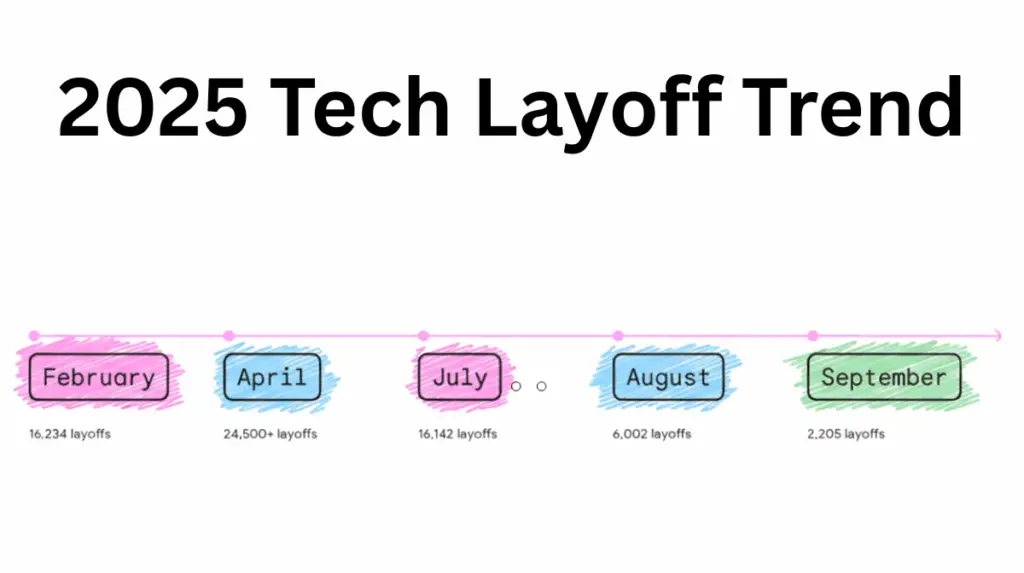
This trend line shows huge peaks in the first half of the year. In April, there were over 24,000 layoffs. Although the numbers have come way down in the last couple of months, the ripple effect from those earlier cuts is still being felt all across the industry.
Table of Contents
Tech Paradox
Here’s the big contradiction, or the Great Tech Paradox. Tech companies are reducing their headcount, but the number of tech jobs across the entire economy is growing.
CompTIA’s monthly report for August showed a net increase of about 247,000 new workers in tech roles.
But in contrast, companies in the tech sector reduced their staffing by a net 2,311 positions. Just to be clear, that net number isn’t tech staff in the tech sector. Some are tech but a lot of that is management and other roles.
Aside from that, the unemployment rate for tech occupations remains low at 3.0%.

Tech Sector Jobs versus Tech Occupations
The industry reports refer to tech sector jobs and tech occupations. Be aware that these aren’t the same thing.
A tech sector job refers to someone working at a tech company but in any role. It could be a sales person or an accountant at Google or Netflix.
A tech occupation means the person does a tech job e.g software development or data engineering. But the person could be working at for a bank or a hospital.
The October reports show falling numbers in the tech sector but rising tech occupations.
This means that tech professionals are finding work, just not in the tech sector itself. They’re moving out of the tech sector to industries like manufacturing or insurance.
AI’s Dual Role
AI has a dual role in the job market.
On one hand, AI skills are driving a massive hiring boom. As of September, a staggering 50% of all U.S. tech job postings required AI skills. That’s 98% up from September of 2024.
On the other hand, companies are citing AI as the reason for layoffs and restructuring.
For example, Amazon announced 14,000 corporate job cuts. Executive Beth Galetti said:
“This generation of AI is the most transformative technology we’ve seen since the Internet…we need to be organized more leanly, with fewer layers and more ownership.”
AI is creating immense demand for new competencies while many corporations are shedding roles in the hope they can make up for them with AI.
Tech Hiring Spikes Beyond Silicon Valley
So, the traditional tech sector is contracting. But other industries are aggressively hiring tech talent.
The latest Dice report looked at the industries with the most explosive year-over-year growth in tech job postings.
Manufacturing leads the way with a stunning 257% increase. That points to a focus on automation. Insurance is next at 182%.
This shift is also geographic. Massachusetts and New Jersey are falling off with a drop of 11% in job postings. But Illinois saw 15% year-over-year growth.
Tech opportunities in the U.S. are no longer concentrated on the coasts. They are dispersing across the country.
October Summary
In summary, October shows a U.S. tech job market in transition.
The economy is cooling which forces belt-tightening and the reallocation of resources across the board.
This is a paradoxical landscape where traditional tech firms are shrinking while non-tech industries are hiring tech talent at a record pace.
Meanwhile, AI is both creating new roles and eliminating old ones.
The result is a fundamental shift in what a tech job is and where you can find one.