You’ve worked hard for that Senior Software Engineer title. Maybe you’re even a Team Lead with direct reports. You’ve got 5 years of solid experience under your belt.
And now you’re thinking about making the jump to Google, where you’ll seamlessly transition into a similar role with better perks and that prestigious Google badge.
Here’s the truth that might sting: You’ll likely be an L4. That’s right, a junior engineer at Google.
Before we dive into why your senior title may translate to junior at Google, you need to understand how Google structures its engineering organization. It’s frustratingly opaque from the outside.
Table of Contents
The Ladder: What You Do
First, there’s your ladder. This is your role.
Are you a Software Engineer (SWE), a Software Engineering Manager, or perhaps a Site Reliability Engineer (SRE)? Each ladder has its own distinct expectations.
If you’re on the Software Engineer ladder, Google expects you to spend at least 50% of your time writing code. You might mentor or manage some team members, but you’re primarily an individual contributor who happens to guide others.
The Manager ladder is a different beast entirely. Here, 80% of your time should be devoted to management activities. Your coding might be limited to proof-of-concepts or demo projects to kickstart features. Stray too far from these ratios, and your performance reviews will reflect it.
The Level: Your Rung on the Ladder

Then there’s your level. This is that famous L-number you’ve seen Google engineers mention on Reddit or Discord. The number represents where you’re placed on the ladder, and it’s where many experienced engineers get a reality check.
Let’s decode what these levels actually mean:
L2: Interns, usually in their final year of college
L3: New grads, fresh out of university
L4: Junior engineers with 1-5 years of experience
L5: Senior engineers with 6-9+ years of experience
L6: Staff engineers leading strategy across multiple teams
L7+: Senior Staff and beyond (rarely hired externally)
L4: Where Most External Hires Land
L4 is considered junior at Google, but it encompasses engineers with up to 5 years of industry experience.
At this level, you work independently on well-defined projects. You solve problems and develop features without handholding, but the requirements are clear. Often because the L5s have been involved in defining them.
PhD graduates often start here. So do engineers with “Senior” titles from other companies. Why? Because Google doesn’t care about title inflation.
What is Title Inflation?
Title inflation is the industry-wide phenomenon where companies hand out impressive-sounding titles that don’t reflect actual responsibilities or impact.
That 50-person startup might have 30 “Senior Engineers” because it helps with hiring and retention.
Some companies make everyone a “Lead” after two years.
Others create titles like “Senior Staff Principal Engineer” for what Google would consider L5 work.
Every company draws the “Senior” line differently. Google can’t rely on these inconsistent external titles, so they assess everyone against their own consistent standards.
This is why your “Senior Software Engineer” title from a mid-size company might still land you at L4. It’s not that Google is dismissing your experience. They’re looking past the label to evaluate what you actually did and the scope of your impact.
L5: The Real Senior Level
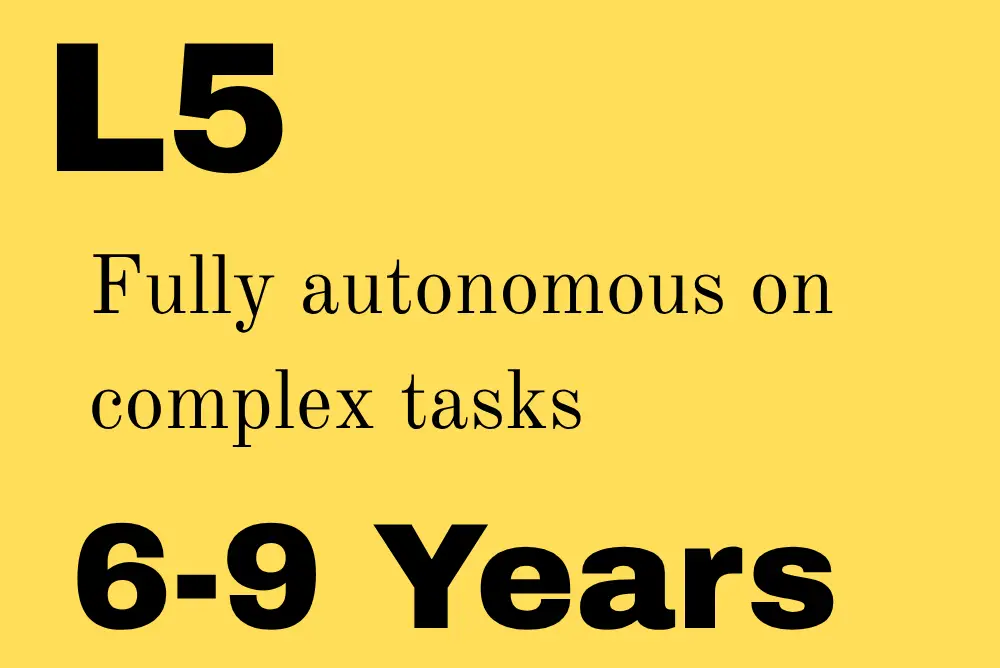
The jump from L4 to L5 is significant.
At L5, you’re not just solving well-defined problems — you’re dealing with messy, ambiguous challenges. You figure out what’s really needed, architect the solution, and deliver it. You might supervise a couple of engineers while still delivering substantial individual work.
Most Google software engineers are L5, and many have successful, well-compensated careers without progressing further.
It’s a respectable plateau, not a stepping stone everyone must pass.
L6 and Beyond: The Strategy League
L6 Staff Engineers operate on a different plane. They lead strategy across multiple teams or entire divisions.
Google rarely hires L6+ from outside because these roles require deep institutional knowledge and proven impact at Google scale. I say rare, but it does happen. You’ll likely need to have make a high impact at a large enterprise.
Years of Experience Does Not Translate to Senior
Ten years of experience doesn’t automatically make you an L5. Google cares about your trajectory and growth, not time served.
Consider two engineers:
Bill has 10 years of experience but spent the last 6 years implementing the same feature across different products. Comfortable, competent, but not growing.
Bob has 5 years of experience, started as an intern, and is now architecting major features from conception to launch, mentoring others, and driving technical decisions.
Google would likely level Bob higher than Bill.
The Interview: Your Real Proving Ground
Here’s the crucial part: Google’s interview process is specifically calibrated to assess your level. Your resume gets you in the door, but the interview determines where you land.
L3-L4 Interviews
At these levels, there is heavy emphasis on algorithms and core coding skills. You need to demonstrate you can code independently and solve problems efficiently.
L5 Interviews
At level 5, coding skills remain important, but system design becomes crucial.
Can you architect large, complex systems? Can you make appropriate trade-offs? Can you think at scale? You need to demonstrate these aspects in the interview.
L6+ Interviews
At L6, the focus shifts to leadership, influence, and strategic thinking across multiple teams and products.
Pro Tips for Level Targeting
- If you’re borderline between L4 and L5, target L5. The hiring committee can down-level good candidates who don’t quite meet the bar. Up-leveling is much harder.
- Many excellent engineers struggle to articulate their architectural thinking. If you’re aiming for L5, invest serious time in system design interview preparation.
- Throughout the interview process, emphasize the business impact of your work. Google values engineers who understand that code is a means to an end.
- Be careful about which ladder recruiters steer you toward. SRE and SWE transfers are possible. But other technical ladders (SET, TSSE) aren’t backdoors to SWE. You’d need to interview again for a ladder transfer.
Should You Still Apply?
After reading all this, should you still apply?
Absolutely. Yes, you might start as an “L4 Junior” despite your senior title elsewhere. But consider:
- Google’s L4 compensation often exceeds senior packages at many companies
- You’ll work on problems at unprecedented scale
- The growth opportunities are real. Many L4s promote to L5 within 2-3 years
- The learning environment is unparalleled
The key is setting realistic expectations. Don’t let your ego derail an opportunity.
If you’re truly operating at a senior level, you’ll likely promote quickly. If you’re not, you’ll grow into it with world-class colleagues and resources.
The Current Reality
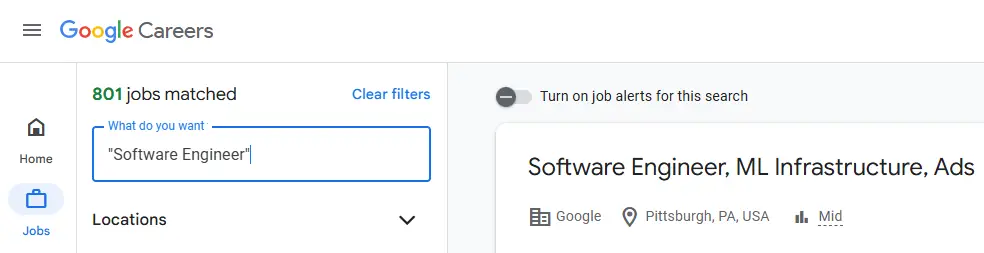
Despite headlines about layoffs, Google continues to hire. The company operates on a “talent refresh cycle”: people leave for startups, retire, or move on. New initiatives need specific expertise. Critical roles need filling.
Those 500+ open positions on Google’s careers page? They’re real needs, not just pipeline building.
The question isn’t whether Google is hiring, it’s whether you’re prepared for their specific evaluation framework.
Remember this: levels are just Google’s way of ensuring consistency across a massive organization. They’re not a judgment on your worth or potential.
Some of the best engineers I know spent years as L4s before becoming L5s who drive massive impact.